threat_models
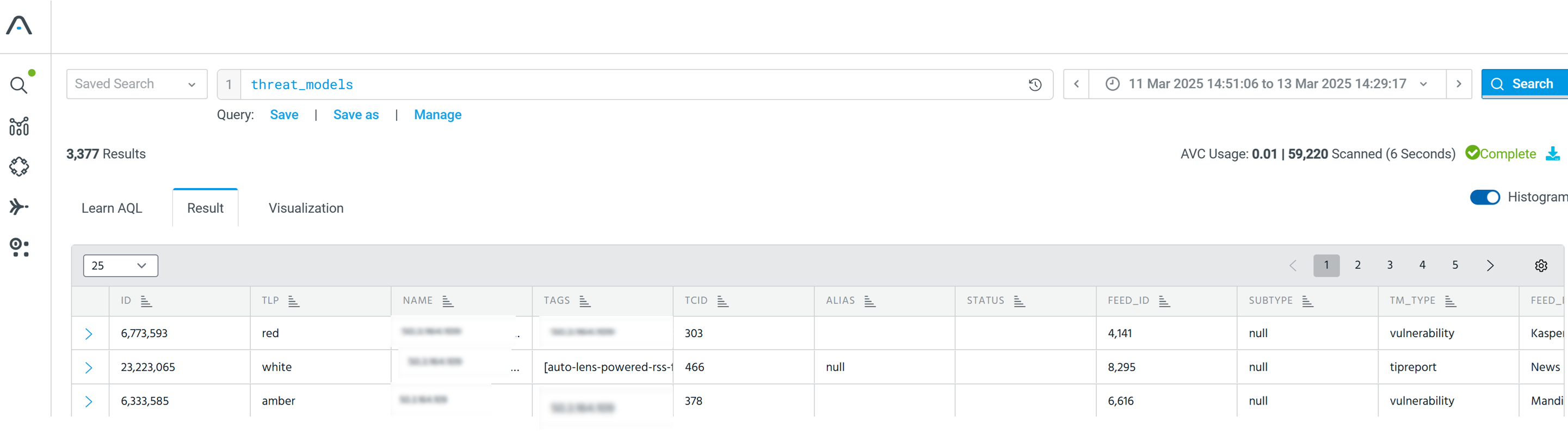
AQL Search supports the out-of-the box threat_models lookup table that contains ThreatStream threat model data from the last 90 days.
To search for these threat models, enter the following lookup table name into the AQL Search box: threat_models.
You can also access the threat_models table on the Lookup Tables page. See Using Lookup Tables for more information.
Threat model data is refreshed once daily.
| Field | Value Type | Description | Example |
|---|---|---|---|
| alias | string | Other names by which the entity is known (Actors, Attack Patterns, Campaigns, Infrastructure, Intrusion Sets, Malware, Tools, TTPs, Vulnerabilities only). | user -> UserName |
| assignee_user_id | double | ID of the user assigned to the threat model. | 393 |
| c2_port | array of strings | Network port(s) used for C2 communications. Applicable to Malware only. | [8080, 443] |
| c2_protocol | array of strings | Protocol(s) used for C2 traffic. Applicable to Malware only. | [HTTP, HTTPS, DNS] |
| capabilities | array of strings | The functions and features of the malware. | [Keylogging, Credential theft, File exfiltration] |
| created_ts | bigint |
Time stamp of when the entity was created on ThreatStream, in UTC format. Date can be specified as follows:
|
2014-10-02T20:44:35 |
| epss_percentile | double |
EPSS percentile. When EPSS data is unavailable the field value is The field works with For example: threat_models
| where tm_type == "vulnerability"
| sort epss_percentile desc
|
|
| epss_score | double |
EPSS score. When EPSS data is unavailable the field value is The field works with For example: threat_models
| where tm_type == "vulnerability" and epss_score > 0.5
|
|
| cvss2_score | double | CVSS 2.0 Score (Vulnerability entities only). Scores range from 0-10. |
|
| cvss3_score | double | CVSS 3.0 Score (Vulnerability entities only). Scores range from 0-10. |
|
| end_date | bigint | When the campaign stopped (if applicable). | 2024-12-15 |
| event_time | bigint | UTC time stamp of when the observable was first created in ThreatStream. | Jun 20, 2025 11:53:15.000 -07 |
| execution_platforms | array of strings | OS or environments the malware runs on. | Windows, Linux, macOS, Android |
| feed_id | bigint | Numeric ID of the threat feed that provided the Threat Model entity. | 2017-01-26T00:00:00. |
| feed_name | string | Name of the feed from which the entity originates. | MITRE ATT&CK PATTERN |
| first_seen | bigint | ||
| id | bigint | ID of the attack pattern entity. This ID is automatically assigned to the entity by ThreatStream at the time of creation. You can use this ID to associate the attack pattern entity with other Threat Model entities. | 17 |
| is_family | boolean | Indicates if this entry describes a malware family. | true, false |
| is_mitre | boolean | Determines whethere the entries are directly sourced from MITRE ATT&CK | true, false |
| locations | array of strings | Specific nation or geographical region to which data, materials, or information is being directed or delivered. | us |
| modified_ts | bigint |
UTC time stamp of when the observable was last updated in ThreatStream. Date can be specified as follows:
|
Jun 20, 2025 11:53:15.000 -07 |
| mitre_data_sources | array of strings | Types of telemetry or logs that can be used to detect the technique. | [Malware reverse engineering, Process monitoring] |
| mitre_defense_bypassed | array of strings | Identifies the defensive controls that the technique is known to circumvent. | [Signature-based detection] |
| mitre_detection | string | Ways in which an org detects the use of a technique. This usually contains hints on the relevant behaviors, artifacts, or anomalies. | Depending on the method used to pad files, a file-based signature may be capable of detecting padding using a scanning or on-access based tool. When executed, the resulting process from padded files may also exhibit other behavior characteristics of being used to conduct an intrusion such as system and network information Discovery or Lateral Movement, which could be used as event indicators that point to the source file. |
| mitre_name | string | Name of the ATT&CK technique or sub-technique, including its ID. | T1027.001 - Obfuscated Files or Information: Binary Padding |
| mitre_id | string | The MITRE ATT&CK technique or sub-technique identifier. | T1027.001 |
| mitre_parent_name | string | If the entry is a sub-technique, this field stores the parent technique’s name. | T1027 - Obfuscated Files or Information |
| mitre_parent_id | string | The MITRE ATT&CK ID of the parent technique for a sub-technique. | T1027 |
| mitre_parent_attackpattern | integer | An internal or database-specific numeric ID representing the parent technique in the dataset. | 9591 |
| mitre_tactic | array of strings | Signifies the higher-level adversary objective. | defense-evasion |
| mitre_type | string | Type of the MITRE ATT&CK. | enterprise-attack |
| name | string | Name of the entity. | T1027.001 - Obfuscated Files or Information: Binary Padding |
| owner_user_id | bigint | ID of the ThreatStream user that created the entity. | T-Mobile USA |
| organization_id | bigint | ID of the organization that owns the entity. | 2 |
| primary_motivation | string | Primary reason, motivation, or purpose behind the Actor. The motivation is why the Actor wishes to achieve the goal. This field is relevant only to Actors and Intrusion Sets. | |
| product_name | string | Identifies which product(s) from the listed vendors are impacted. | Exchange Server 2016 |
| publication_status | string | Current stage in the publishing workflow. |
|
| secondary_motivation | array of strings | The additional, secondary goals of a threat actor. This field is relevant only to Actors and Intrusion Sets. | Destruction |
| sophistication | string | Assessment of skill, resources, and operational maturity. This field is relevant only to Actors. | No Type (Default), Novice, Innovator, Expert, Practitioner, Aspirant. |
| source_locations | array of strings |
Source locations associated with the Threat Model entity. Possible values include letter codes of regions, countries, and administrative areas (US States and Washington DC only) as defined by STIX 2.1. |
Here are some examples:
|
| start_date | bigint |
Time when a campaign was known to have started. Date (in UTC) must be specified in this format: YYYYMMDDThhmmss, where T denotes the start of the value for time. |
|
| status | string | Current state of the observable in ThreatStream. |
|
| subtype | array of strings |
Provides further categorization of threat model information, as per the following threat model types:
|
|
| tags | array of strings | Additional comments and context associated with the observable when it was imported from its original threat feed. | [T1556.009, attack-pattern--ceaeb6d8-95ee-4da2-9d42-dc6aa6ca43ae] |
| target_industry | array of strings | Target industries associated with the Threat Model entity. Possible values are defined by the STIX 2.1 Industry Sector vocabulary |
|
| tcid | integer | Unique reference of a MITRE ATT&CK technique, sub-technique, or related object. | 145 |
| threat_actor_types | array of strings | Categorizes the type of Actor based on operational profile. | Nation-state |
| tlp | string |
TLP color associated with the Threat Model Entity. The TLP color provides a mechanism to communicate to consumers of the information whether further dissemination of this information is allowed; if yes, how freely can this information be distributed. |
|
| tm_type | string | Type of the threat model. |
tipreport vulnerability |
| trusted_circle_ids | array of integers | ID of the trusted circle with which the observable is shared. These IDs can be used for querying entities associated with specified trusted circles. | [145] |
| trusted_circle_names | array of integers | Names of trusted circles. | [Anomali Threat Research Premium] |
| vendors | string | Vendor(s) affected by the Vulnerability. | [Microsoft, Cisco] |